

History of Compressors

Luglio 28, 2017
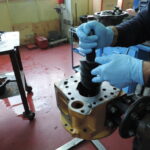
Everyone in industry now uses compressed air, and indeed, it would be more accurate to say that we can no longer do without it. But what is the history of compressed air? How did we arrive at the machines we use today? Let’s begin this journey into the past—useful for better understanding the present and, above all, the future—with pistons: what were the first ones like? First of all, it should be clarified that the first pistons used for compressed air machines were derived from engines. Single-stage compressors (i.e., those with one or two pistons) were made of die-cast aluminum. And what about two-stage compressors? They were manufactured in two different ways: either in die-cast aluminum or in cast iron—in the first case, those of the first low-pressure stage, and in the second case, those of the second high-pressure stage. The crankcases were also made of cast iron and, later, were made of sand-cast aluminum and finally die-cast aluminum. Let’s now move on to the cylinders: the first cylinders were all made of cast iron, with the resulting – and imaginable – mechanical processing costs being much higher than today. In this case, over the years, extensive research was carried out to find ways to take advantage of the construction and use of cylinders. This led to the current shape of the cylinders: cast iron ‘jackets’ to be embedded in a die-cast aluminum cylinder. Finally, how did we arrive at the dry compressor? In the past, oil-lubricated piston pumping units had many disadvantages: first of all, they had to be kept strictly vertical to prevent the oil from leaking out, and the oil itself had to be topped up continuously (and therefore checked continuously). The need to ‘invent’ a compressor that would work without oil, i.e., ‘dry’, became increasingly urgent. Thus, thorough research was also conducted on this element, which, over the years and thanks to a German chemical company—and a couple of patents—led to the development of the oil-free compressors that we know and use today.