

Centrifugal Compressor
Febbraio 1, 2017
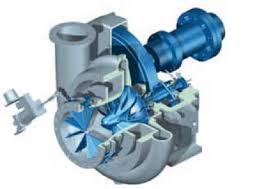
A centrifugal compressor is a turbomachine in which a rapidly rotating impeller is inserted to supply energy to a compressible fluid in order to increase its pressure.
The use of a centrifugal compressor can save a considerable amount of energy.
The impeller is equipped with diverging blades in which the first part of the compression phenomenon takes place.
The diffuser is also equipped with blades that help slow down the air and transform kinetic energy into pressure.
After compression has taken place, a delivery manifold slows down the air and directs it either outside or to the next stage.
Centrifugal compressors are ideal for this type of application, which requires a consistent supply of air 24 hours a day, all year round.
For a correct assessment of opportunities for improvement, it is important not to make the mistake of considering centrifugal compressors in the same way as volumetric compressors.
This is because the latter are more common and more intuitive, while the laws of dynamic compression remain something of a mystery, the solution to which is secretly guarded by those in the know, but in reality there is nothing complex about it.
The compression process: the compression work is produced by the centrifugal force generated by the air passing through an impeller and a diffuser.
This work is originated by the conversion of kinetic energy into potential energy.
The curve refers to the possible operating conditions at full load.
Obviously, if the air flow decreases, the pressure will tend to increase.
Every compression process is dependent on air density, and the conditions that determine air density are temperature and pressure.
The compression ratio increases as the amount of air drawn in increases, and consequently, the force required to pump a given volume of air increases.
When a machine operates at too low a pressure, the flow rate can be such that the air reaches sonic speeds at the diffuser inlet.
Once this limit is reached, the machine is unable to increase the flow rate even if the delivery pressure decreases.