

How to cool compressors: air and water systems
Aprile 13, 2021
Compressors, just like most motorized machines, need to be cooled when they overheat (think of computers, for example). How can industrial compressors be cooled? There are two main methods, depending on the type of compressor: air cooling or water cooling.
How air and water compressors are cooled
In the following paragraphs, we will look at how a compressor is cooled, bearing in mind that, if water cooling is chosen, there are three cooling methods. Let’s look at everything in detail
Air cooling of a compressor
Almost all current compressors are compatible with air cooling. Cooling is achieved by fans that push air flows through the internal radiators of the machines. In this case, the air ventilation contains 100% of the energy consumed by the electric motor. In some cases, it is possible to optimize compressor cooling by using radiators on the side where the highest pressure is exerted in order to perform a sort of pre-heating. A stop fan can also be used to achieve greater energy savings.
FURTHER INFORMATION: Compressed air compressors, how to optimize costs
Water cooling of a compressor
As mentioned above, water cooling of a compressor can be carried out in three different ways. Let’s start with a fact: the more the compressed air is cooled in the intercooler, the greater the efficiency of the compressor in the face of greater water vapor condensation. In fact, the cooling water contains about 90% of the energy absorbed by electric motors in the form of heat.
The three water cooling systems can be summarized as follows:
- Open systems without water circulation
- Open systems with water circulation
- Closed systems with water circulation
In the first case, the cooling water is supplied by an external source, which can be a body of water (river, lake, well, etc.) or a water network. Once it has passed through the compressor, the water is discharged as waste water. This system must be regulated by a thermostat in order to control the temperature and water consumption at all times. This first system is not very economical, but it is simple to install.
In the open system with water circulation, the water is cooled inside the compressor and then in a cooling tower, which has the task of dripping the water into the chamber where the air is compressed. This system is not very advantageous if you want to keep water contamination to a minimum.
The closed system with water circulation involves continuous water circulation between the compressor and the external heat exchangers, which are in turn cooled by water or air. These systems require low maintenance costs if installed correctly.
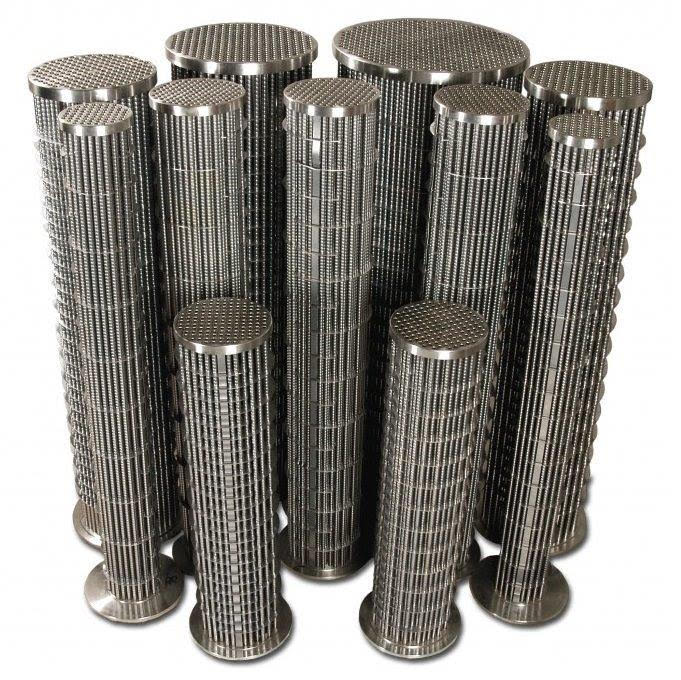
DISCOVER OUR HEAT EXCHANGERS: Z series compressor heat exchangers